

Short answer first, since that's usually why people click on a comparison page: I reach for CeraVe PM Facial Moisturizing Lotion most nights, and I keep a jar of Cetaphil Rich Hydrating Night Cream in the drawer for the weeks my skin wants something heavier. They read like they should be interchangeable, two drugstore night moisturizers marketed at the same dry-skin shopper, but they behave differently once they're actually on your face. One is a thin, oil-free lotion built around ceramides and niacinamide. The other is a thicker, richer cream leaning on hyaluronic acid and glycerin. I bought both with my own money, used each one nightly for a full month, and wrote down what happened before I let myself form an opinion.
I'm fifty-four, my skin has been drier for about six years now, and the tight, flaky feeling around my nose and chin by January is what sent me looking for a real nighttime step in the first place. I'm not a chemist and I won't pretend I can explain ceramide science better than the people who formulated either product. What I can tell you is what showed up on my own skin, on which mornings, and how each one felt going on at 10pm with the lamp already dimmed. I also asked two friends who deal with similar dry patches to try a small amount of each so I wasn't just generalizing from one face, though the week-by-week notes below are mine alone.
| CeraVe PM Facial Moisturizing Lotion | Cetaphil Rich Hydrating Night Cream | |
|---|---|---|
| Texture | Thin, lotion-like, sinks in within a minute | Thick, cream-like, sits on skin for several minutes before absorbing |
| Key Actives | Three ceramides, niacinamide, hyaluronic acid | Glycerin and hyaluronic acid, no listed ceramide blend |
| Size | 3 fl oz pump bottle | 3 fl oz jar |
| Price Band | Low double digits at today's price | Low double digits at today's price, occasionally a touch higher |
| Finish Under Makeup | Fully absorbed by morning, no residue on the pillowcase | Some tackiness left by morning if applied heavily |
| Fragrance | Fragrance-free | Fragrance-free |
| Best For | Normal to dry skin, or anyone who dislikes a heavy feel at night | Very dry or flaking skin that wants a thicker barrier overnight |
| Availability | Widely stocked on Amazon with fast shipping | Also on Amazon, though stock and jar sizes vary more by seller |
The Ingredient Lists, Side by Side
The label difference matters more than it looks like at a glance. CeraVe PM is built around three ceramides plus niacinamide, and ceramides are the fatty molecules already sitting in the outer layer of your skin, holding it together like mortar between bricks. When that layer thins out with age, which it does for most of us by our fifties, skin loses water faster and starts to feel papery by afternoon. Adding ceramides back through a moisturizer is a straightforward idea, not a miracle claim, it's just replacing something your skin is already short on.
Cetaphil's cream takes a different approach. Instead of ceramides, it leans on glycerin and hyaluronic acid, both humectants that pull water into the skin's surface rather than reinforcing the barrier underneath it. That's not a lesser strategy, it's just a different one, and it's part of why the Cetaphil cream feels richer going on. Humectant-heavy formulas tend to sit thicker until they've had time to draw in moisture, which lines up exactly with what I felt on my own face: slower to absorb, but noticeably plush on a night when my skin was at its driest.
How I Tested Both, Side by Side
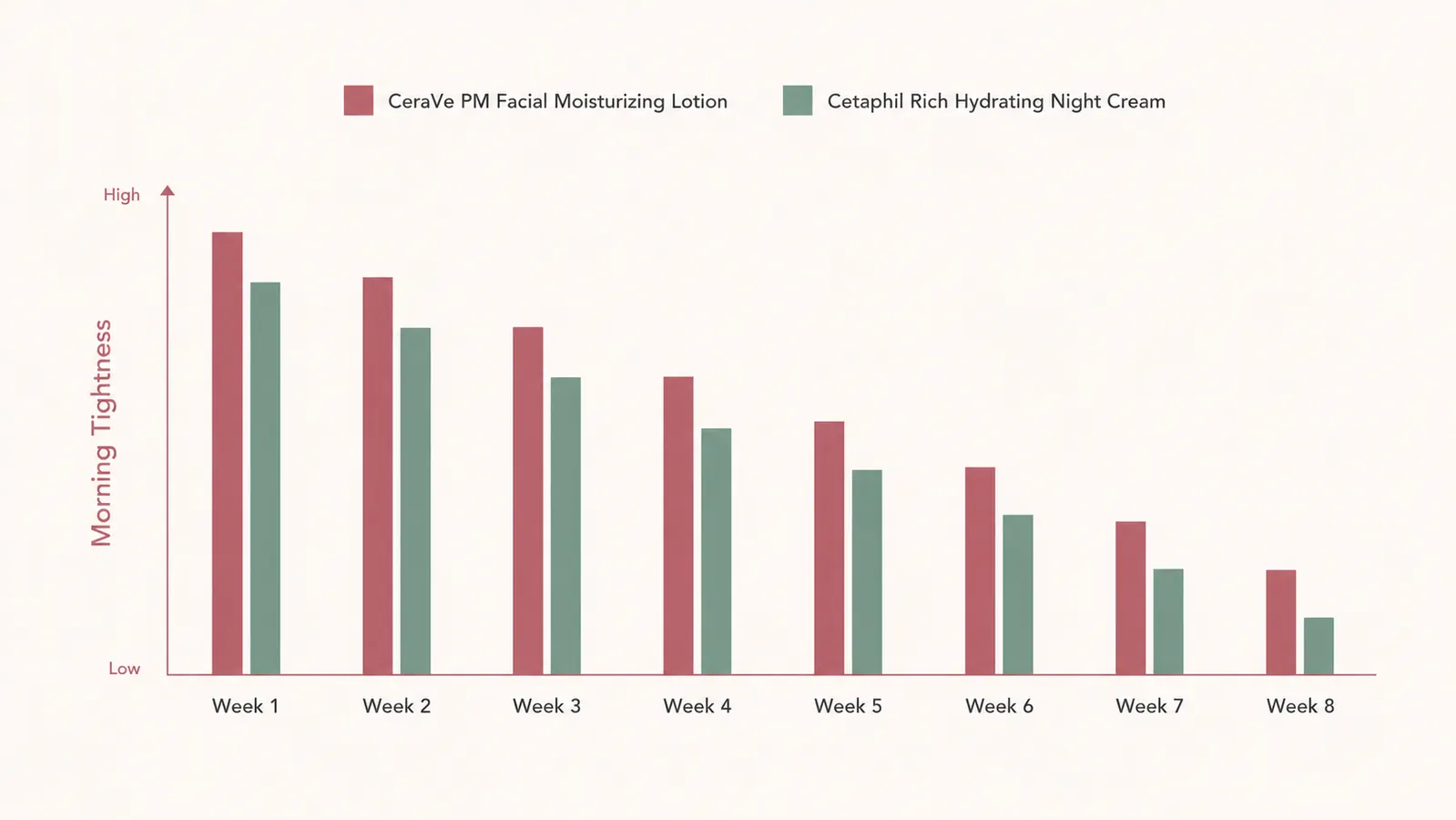
I didn't run them at the same time, because I wouldn't have been able to tell which one deserved credit for a good morning or blame for a bad one. I used CeraVe PM nightly for four weeks first, on a clean, dry face after my usual cleanser, then gave my skin a one-week break with nothing but a plain drugstore lotion, then ran the Cetaphil cream nightly for four weeks the same way. Same pillowcase, changed on the same schedule. Same room temperature, since my house runs dry in winter regardless of what's on my face.
I kept a small pad by the sink and wrote down two things every morning: how tight my skin felt by 9am, before coffee or makeup, and whether I could see any flaking around my nose or jawline under the bathroom light I use to get ready. It's not a lab study and I'm not going to dress it up as one. It's eight weeks on one fifty-four-year-old face, but it's more specific than a lot of what gets written about these two products by people comparing ingredient lists instead of actually applying either one. I also noted how long each bottle took me to reach for a second time in a row without thinking about it, which turned out to be a more honest signal than anything I wrote down about texture.
Where CeraVe PM Wins
The biggest difference for me was how each one wore overnight. CeraVe PM is oil-free and thin enough that it disappears into my skin within a minute or two, so I never woke up with anything shiny on my forehead or a greasy mark on the pillowcase. Four weeks in, the ceramides seemed to be doing real work on the rough patches along my jawline, and they'd noticeably softened by the end of the trial. That's the part I read more about in my long-term review, where I tracked the same jawline patch for six months instead of four weeks.
Price and stock were the other quiet win. CeraVe PM has stayed easy to find on Amazon every time I've reordered, at a price that's stayed low enough I never think twice about restocking. The niacinamide in it also seemed to calm the faint redness I get under my nose in cold weather, something I didn't notice the Cetaphil cream doing to the same degree, though I want to be careful not to oversell that. It calmed the redness, it didn't erase it, and I still get a rough patch after a long day outside regardless of which one I'm using that week.
There's also the simple fact that a thinner lotion is easier to use correctly. With the Cetaphil cream I had to think about how much to scoop, and I over-applied more than once in the first week, which is exactly what led to the tackiness I mention below. With CeraVe PM, one pump has been the right amount every single night without me having to guess.
Where Cetaphil Rich Hydrating Night Cream Wins
I want to be fair here, because the Cetaphil cream earned its place in my drawer. On the driest weeks, the kind where my heater's been running nonstop for days and my skin feels like paper by evening, the thicker texture held up better through the night than the CeraVe lotion did. I'd wake up with less tightness on those specific mornings, and a couple of times I layered the Cetaphil cream on top of the CeraVe lotion for extra insurance on the worst nights, which worked better than either one alone.
The jar format also has an honest advantage for anyone with dry, cracked hands in winter, since you can scoop with a finger instead of relying on a pump that can feel finicky when your knuckles are sore. The tradeoff is that a cream this rich sometimes left a slight tackiness by morning if I used more than a thin layer, and I noticed it more on my pillowcase than I did with the lotion. If your skin runs closer to very dry than moderately dry, that tradeoff might be worth it. If your skin sits somewhere in the middle, it probably isn't.

Jar Versus Pump, and Why That's Not a Small Detail
I didn't expect the packaging to matter as much as it did. A pump bottle stays sealed between uses, so nothing but the product itself ever touches the opening. A wide jar means dipping a finger in every night, which isn't unsafe, I've done it for years with other products, but it does mean being a little more careful about washing your hands first, especially if you're applying other things right before bed. It's a minor habit, not a real drawback, but it's the kind of detail that never shows up on the label and only becomes obvious once you've lived with both for a few weeks.
Fragrance-free labeling is identical on both bottles, and neither one caused any stinging or breakouts for me over eight weeks, which matters since my skin has reacted badly to scented night creams in the past. That said, fragrance-free isn't the same as reaction-free for everyone. One of the friends who tried a small amount of the Cetaphil cream noticed mild congestion around her hairline after about ten days, which cleared up once she switched back to a thinner formula. That's a sample size of one person, not a pattern, but it's worth mentioning since a rich, occlusive cream can sit heavier on skin that's prone to clogging along the hairline or jaw.
The one that's stayed on my nightstand since October
If you want the lighter option that still handled my dry patches without leaving anything on the pillowcase, this is the bottle I keep reordering. Current price and availability are on Amazon.
Amazon Check Today's Price on Amazon →Neither one fixed my skin overnight. The difference showed up in how my face felt at 9am, not in some dramatic before-and-after.
Who Should Buy Which
If your skin is dry but not extreme, and you dislike anything heavy or tacky before bed, CeraVe PM Facial Moisturizing Lotion is the one I'd start with. It's what I've used most consistently, and I wrote up the unfiltered version, including what didn't impress me, in my honest review. If your skin is genuinely flaking by the end of the day or you live somewhere with dry winter heat running for months at a time, the Cetaphil cream's thicker texture may earn its keep, especially layered under something lighter the rest of the year.
There's also a middle option worth naming plainly: some weeks call for the lighter one, some call for the richer one, and there's nothing wrong with owning both and switching based on the season, which is exactly what I ended up doing after two months of testing. Either way, if you're still deciding whether a dedicated nighttime step is worth adding at all, I walked through that question separately in this piece, including how I decided it was worth the extra minute in my routine.
Still deciding? Here's the one I'd restock first
After two months of testing both, this is the bottle I'd be most annoyed to run out of. See current pricing for yourself before you decide.
Amazon Check Today's Price on Amazon →