
Short answer first, since that is usually why someone clicks on a comparison page. I reach for Neutrogena Ultra Sheer Sunscreen Serum SPF 60 most mornings, and I keep a tube of EltaMD UV Clear SPF 46 in the medicine cabinet for the weeks when my skin is flaring or freshly treated and wants something gentler. On paper the two sound like they should be interchangeable, a facial sunscreen is a facial sunscreen, but they behave differently once they are actually on your face at 7am. One is a thin, nearly invisible chemical-filter serum. The other is a mineral-only lotion built around zinc oxide and niacinamide that dermatology offices have been recommending for years. I bought both with my own money, wore each one daily for a month, and wrote down what happened before I let myself form an opinion.
I am fifty-two, my skin runs combination with occasional redness across my cheeks, and a dermatologist appointment three summers ago is what finally got me to treat daily sunscreen as a non-negotiable step instead of something I only remembered at the beach. I am not a chemist and I will not pretend I understand every filter's mechanism better than the people who formulated either product. What I can tell you is what showed up on my own skin, on which afternoons, and how each one felt going on before makeup. I also handed a small amount of each to my sister, who has more reactive skin than I do, so I was not just generalizing from one face, though the week-by-week notes below are mine alone.
| Neutrogena Ultra Sheer Sunscreen Serum SPF 60 | EltaMD UV Clear SPF 46 | |
|---|---|---|
| SPF and Filter Type | SPF 60 using a blend of chemical filters, absorbed into skin | SPF 46 using mineral-only zinc oxide, sits on top of skin |
| Texture Going On | Thin, watery serum, disappears within a minute | Lightweight lotion, slightly more slip, silky rather than powdery |
| White Cast | None noticeable on my skin tone | Faint cast right after application, fades as it sets |
| Wear Under Makeup | Can pill slightly if foundation goes on too soon after | Known for a smooth base, favored by makeup artists for this reason |
| Fragrance and Sensitivity | Fragrance-free, mild stinging near my eyes on humid days | Fragrance-free, formulated with niacinamide for reactive or post-procedure skin |
| Size | 1.7 fl oz pump bottle | 1.7 fl oz flip-top tube |
| Price Band | Well under $20 at today's price | Roughly double to triple that at today's price |
| Where to Buy | Any drugstore or Amazon, always in stock, fast reorders | Dermatology offices, Amazon, and Sephora, stock varies more by seller |
How I Actually Tested Both, Side by Side
I did not wear them at the same time, because I would not have been able to tell which one deserved credit for a good day or blame for a shiny nose by 2pm. I wore Neutrogena Ultra Sheer Sunscreen Serum every morning for four weeks first, applied after my moisturizer and before makeup, then gave my skin a few days with a plain drugstore SPF while I restocked, then wore EltaMD UV Clear daily for four weeks the same way. Same amount, roughly a quarter-teaspoon for my whole face, since under-applying sunscreen is the most common mistake I made in the years before I started paying attention to it.
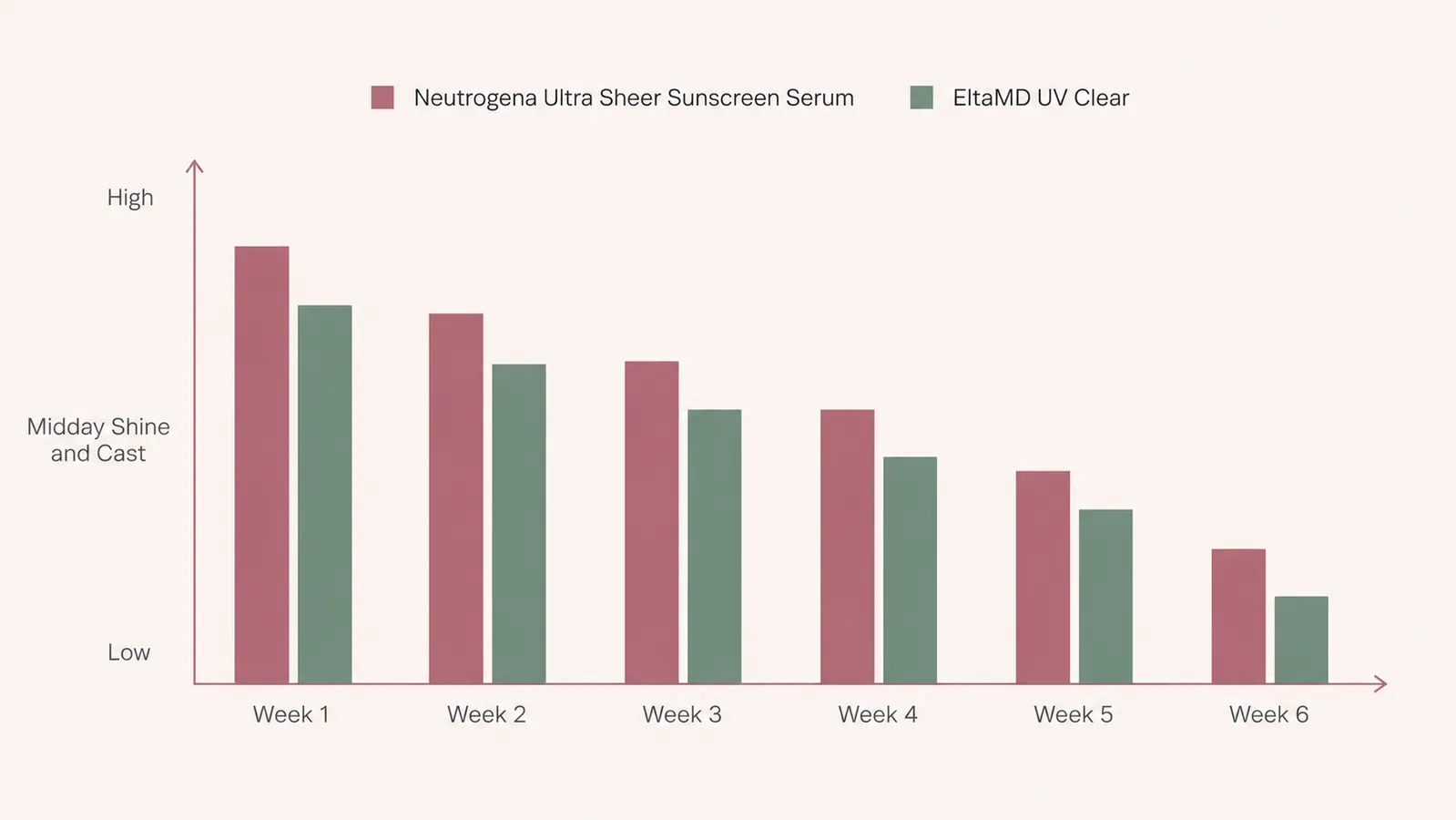
Every afternoon around 2 or 3pm I checked my face in the same bathroom mirror and wrote down two things: whether I looked shiny along my nose and forehead, and whether my under-eye concealer had started to separate or crease. It is not a lab study and I am not going to dress it up as one. It is eight weeks on one fifty-two-year-old face, but it is more specific than a lot of what gets written about these two products by people comparing ingredient lists instead of actually wearing either one through a full workday. I also noted which bottle I reached for without thinking twice on a rushed morning, which turned out to be the most honest signal in the whole exercise.
Where Neutrogena Ultra Sheer Sunscreen Serum Wins
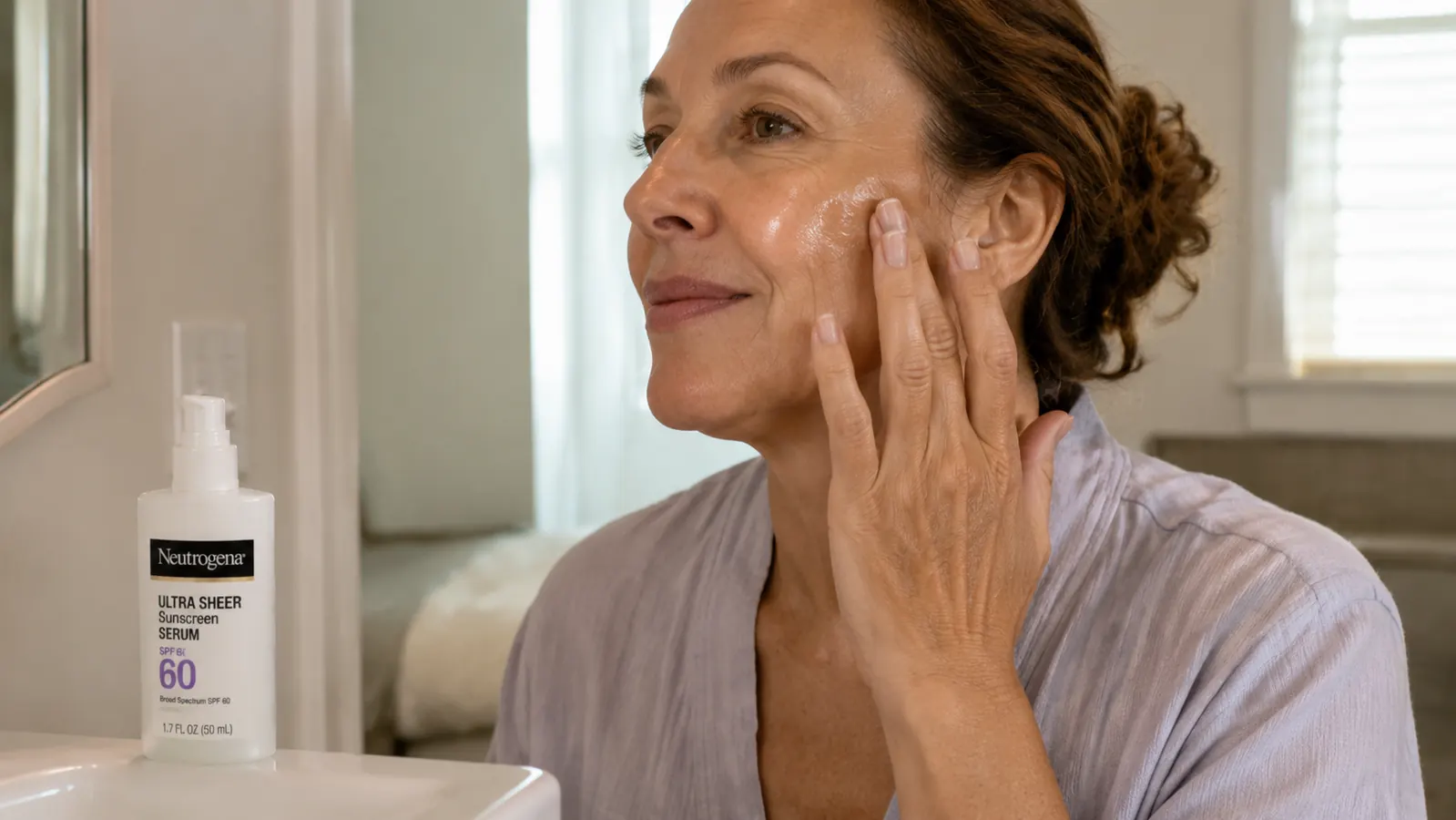
The biggest difference for me was how invisible it was going on. The serum texture sinks in fast, and I never had to wait around before I could move on to concealer, which matters on a weekday morning when I am also trying to get out the door. Four weeks in, I had not noticed any white residue in my hairline or along my jaw, something that mattered because I wear my hair pulled back most days and any leftover cast shows up immediately. I go into more of that stretch in my long-term review, where I tracked the same bottle across a full summer instead of four weeks.
Price and stock were the other quiet win. Neutrogena Ultra Sheer Sunscreen Serum has stayed easy to find at every drugstore near me and on Amazon whenever I have reordered, at a price low enough that I do not think twice about restocking a bottle every couple of months, which matters for a product you are supposed to reapply generously and often. SPF 60 also gives me a little more room for error on days when I forget to reapply at lunch, which happens more often than I would like to admit.
There is also a practical point that does not show up in ingredient comparisons. A pump bottle is easier to dose consistently than a squeeze tube, and I found myself using the correct amount without measuring, where I had to think more deliberately about how much to squeeze from the EltaMD tube. The unfiltered version of this bottle, including the mornings it did not impress me, is in my honest review if you want the fuller picture before you decide.
Where EltaMD UV Clear Wins
I want to be fair here, because EltaMD earned its spot in my cabinet. On the weeks my skin was reactive, either from a new retinol or just from a stretch of poor sleep and stress showing up on my cheeks, the mineral-only formula sat more calmly on my face than the chemical-filter serum did. I did not get the faint stinging near my eyes that I noticed with Neutrogena on a couple of humid mornings, and my sister, who reacts to chemical sunscreens more than I do, said the same thing after trying a small amount for a week.
The finish also earned its reputation. EltaMD UV Clear genuinely wears well under makeup, my foundation sat smoother and lasted longer on the days I used it, and I understand why it gets recommended so often by people who spend all day around makeup artists and dermatologists. If your skin is easily irritated, freshly treated after a procedure, or you specifically want to avoid chemical filters, that tradeoff in price is probably worth it. It is a more targeted product for a more specific kind of skin, and it delivers on that specific promise.
The one that's stayed in my bathroom drawer since June
If you want the lighter, budget-friendly option that still held up through full summer workdays without a white cast, this is the bottle I keep reordering. Current price and availability are on Amazon.
Amazon Check Today's Price on Amazon →Neither one made my skin look different by the mirror at 7am. The difference showed up by 2pm, in whether I still looked like myself or looked shiny and tired.
Chemical Versus Mineral, and Why That Distinction Actually Matters
The filter type is the real fork in the road between these two, more than the SPF number on the front of the bottle. Neutrogena's serum uses a blend of chemical filters that absorb into the skin and convert UV rays into heat, which is part of why it disappears so completely and never leaves a cast. EltaMD relies entirely on zinc oxide, a mineral filter that physically sits on top of the skin and reflects UV rays instead of absorbing them, which is part of why dermatologists lean on it for skin that is already inflamed or recovering from a procedure. Neither approach is superior across the board. They are simply built for different starting points.
That distinction is also why I do not think of this as picking a permanent side. My own routine now leans on the Neutrogena serum for ordinary days and switches to EltaMD for the week or two after I try a new active ingredient or when my skin is already cranky about something else entirely. If you are still deciding whether sunscreen deserves a dedicated daily step at all rather than an afterthought, I walked through why I finally treated it that way in this piece, including the specific morning that changed my mind.

Price, Size, and Where I Actually Buy Each One
Both bottles come in the same 1.7 fluid ounce size, so the price gap is not about getting less product, it is about the formulation and the brand behind it. Neutrogena's price band has stayed comfortably under twenty dollars every time I have reordered, and it is sold everywhere from the corner drugstore to Amazon with same-week delivery, which matters a lot for a product you are supposed to be reapplying every couple of hours if you are outside for any length of time. EltaMD runs noticeably higher, closer to two or three times that price depending on the retailer, and while Amazon carries it, I have had better luck buying directly through a dermatology office or a retailer that lists EltaMD as an authorized seller, since third-party sunscreen listings are worth double-checking before you buy. A sunscreen you hesitate to reapply because of cost is not really doing its job, and that gap in reorder friction is a bigger deal than it sounds on paper.
Who Should Buy Which
If your skin tolerates chemical sunscreens fine and you want an everyday bottle you will not hesitate to reapply because of the price, Neutrogena Ultra Sheer Sunscreen Serum SPF 60 is the one I would start with. It is what I reach for on most ordinary mornings, and it has been the easiest habit to keep consistent precisely because restocking it never feels like a splurge. If your skin is reactive, freshly treated, or you specifically want to avoid chemical filters, EltaMD UV Clear's mineral-only formula is worth the higher price for the weeks you need it, even if it does not become your daily default.
There is also a middle option worth naming plainly. Some weeks call for the budget-friendly everyday bottle, some call for the gentler mineral one, and there is nothing wrong with keeping both on hand and switching based on how your skin is behaving that month, which is exactly what I ended up doing after two months of testing. If pilling under makeup has been your main frustration regardless of which sunscreen you land on, the fix usually comes down to letting each layer set fully before the next one goes on, patting instead of rubbing, and giving the sunscreen a full sixty seconds before foundation touches it. That single change did more for both bottles than switching products ever did.
Still deciding? Here's the one I'd restock first
After two months of wearing both through full workdays, this is the bottle I would be most annoyed to run out of. See current pricing for yourself before you decide.
Amazon Check Today's Price on Amazon →