

I'm Vivian Slade, and for a long time I treated my morning puffiness as one single problem with one single fix, which turned out to be the wrong way to think about it. Some of what shows up under my eyes at 7am is fluid, the kind that responds to a cool compress and a decent night's sleep. Some of it is just the shape of my face now, in my fifties, and no amount of tapping or cooling was ever going to change that part. What actually helped was learning to tell the two apart, then building a short routine around a retinol eye cream, RoC Retinol Correxion Under Eye Cream, that addresses the part that's actually fixable. Here's that routine, step by step, plus what four honest weeks of following it looks like on my own face.
One caveat before the steps, because I think it matters more than any single technique below. Ordinary morning puffiness, the kind that's worse after a salty dinner or a short night of sleep and better by midday, is a reasonable thing to manage with a routine like this one. Sudden swelling, puffiness that only shows up on one side of your face, or puffiness that comes with pain, redness, vision changes, or any other symptom, isn't something a cream is built to sort out. That's a conversation for a doctor, not a step-by-step guide, and I'd rather say that plainly up front than let anyone read past it.
Waking Up Puffy Isn't Always About How You Slept
I spent years blaming a bad night's sleep for puffiness that was actually a mix of fluid I could manage and structure I couldn't. Sorting out which was which, and building a short routine around a targeted eye cream, changed my mornings more than any single trick did on its own. Here's the whole routine below, plus where to check today's price if you want to start with the same tube.
Amazon Check Today's Price on Amazon →Step 1: Tell Fluid Puffiness From Structural Hollowing First
This is the step I skipped for years, and skipping it wasted a lot of money on products that were never going to do what I wanted. Fluid puffiness looks worse first thing in the morning and tends to soften somewhat as the day goes on, especially once you've been upright and moving for an hour or two. Press a fingertip gently against it and it usually has a slight give, a softness, because there's actual fluid sitting there under the skin. It also tends to track with obvious causes, a salty dinner, a short night, a cocktail before bed, crying, or seasonal allergies flaring up.
Structural puffiness, sometimes called under-eye bags in the more permanent sense, looks about the same in the morning and the evening, doesn't soften much as the day goes on, and tends to show up gradually over years rather than overnight. It's often related to the fat pads under the eyes shifting position and the skin around them losing some of its former tightness, which is a normal part of getting older rather than a sign anything is wrong. I have some of both. My fluid puffiness responds well to everything below. The structural part, the permanent slight fullness that's simply there now, doesn't move much no matter what I do, and I've made my peace with that being a separate issue that a topical cream isn't built to reach.
Step 2: Start the Day With a Two-Minute Cool Compress
Before any product goes on, I do a cool compress, since it's the fastest way to bring down actual fluid and it makes the eye cream that follows go on smoother. I wet a clean washcloth with cold water, wring it out so it's damp rather than dripping, and press it gently under both eyes for about two minutes while I do something else, brush my teeth, check the coffee maker, whatever's next in the morning. Chilled metal spoons kept in the freezer work the same way if you'd rather not deal with a wet cloth, and a lot of people already have a pair on hand without buying anything new.
This step alone visibly softens the puffiest mornings for me, the ones after a salty dinner or a short night. It doesn't do anything for the structural fullness that's simply how my face is shaped now, and I don't expect it to. I treat the compress as the fast fix for the fluid, and the eye cream that follows as the slower, cumulative piece that works over weeks rather than minutes.
Step 3: Use a Rice-Grain Amount and Pat It In With Your Ring Finger
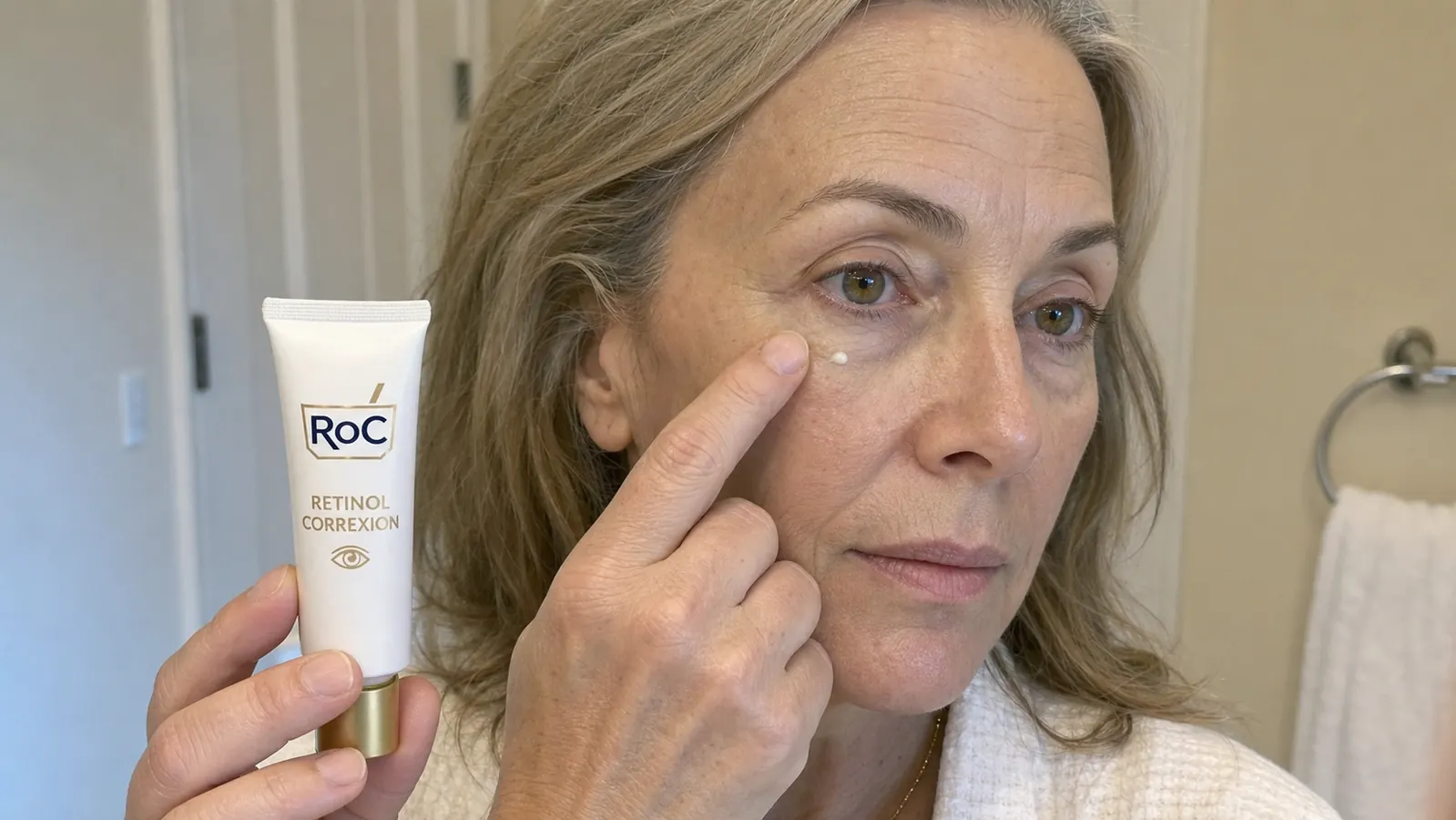
The skin under the eye is thinner than almost anywhere else on the face, and more product isn't better here, it just sits on the surface and can migrate into your eyes and sting. I use an amount roughly the size of a grain of rice for both eyes combined, not per eye, warmed slightly between my fingertips first so it spreads more evenly. I always use my ring finger to apply it, since it's naturally the weakest finger and applies the lightest pressure, which matters on skin this delicate. I dot small amounts along the orbital bone, the bony ridge under the eye, rather than dragging the cream across the skin, and I tap it in with light pressing motions until it disappears rather than rubbing it in the way I'd rub in a body lotion.
If you're new to RoC's retinol formula this close to your eyes, ease in rather than starting nightly right away. I began every other night for the first two weeks, watched for any redness or flaking the next morning, and moved to nightly once my skin tolerated it without complaint. A small amount of dryness at the outer corners in the first week is common and usually settles on its own within a week or two.
Step 4: Keep the Cream Well Below Your Lash Line
This is a small detail that matters more than it sounds like it should. I keep the cream at least a few millimeters below my lash line and away from my inner corners entirely, where the skin is thinnest and where migration into the eye itself is most likely. It's tempting to get the product as close to the lash line as possible, thinking that's where puffiness is worst, but that's also exactly where irritation and stinging show up first, especially with RoC's retinol formula.
I dot the cream on the bony ridge of the orbital area, let it absorb there, and let it do its work from a slightly safer distance rather than chasing the exact spot the puffiness sits. If any cream does end up too close to the lash line, or migrates in while you sleep, rinse with plain water rather than pushing through mild stinging, since that's your skin telling you the placement needs to move back next time.

Step 5: Adjust Sleep Position, Salt, and Alcohol, the Three Levers That Matter More Than Any Cream
No eye cream works against gravity and fluid retention on its own, and I learned that the hard way before I started paying attention to what actually happens the night before a puffy morning. Sleep position is the first lever. Fluid pools under the eyes overnight when you sleep flat, so I added a second pillow to keep my head slightly elevated, which sounds like a small thing and made a noticeably visible difference within the first week I tried it. Stomach sleeping tends to make puffiness worse for the same reason, since it lets fluid settle right where you don't want it.
Salt is the second lever, and it's the one I underestimated longest. A salty dinner, the kind with restaurant sauces or takeout, reliably shows up on my face the next morning, more so than almost anything else I've tracked. I'm not cutting salt out entirely, but I've gotten more honest with myself about which dinners are going to cost me a puffier mirror the next day, and I plan accordingly on mornings that matter. Alcohol is the third lever and works the same way, since it dehydrates you and your body tends to retain fluid to compensate, which shows up under the eyes before almost anywhere else. A glass of wine on an ordinary Tuesday isn't a crisis, but I've noticed the pattern is real and consistent enough that I don't ignore it anymore.
Step 6: Decide Whether Morning, Night, or Both Makes Sense for You
I use this specific RoC eye cream at night rather than in the morning, mostly because it's built around a retinol, and retinol formulas generally do better without direct sun exposure over them during the day. Applying it at night also fits naturally into the rest of my nighttime routine, after cleansing and before whatever moisturizer comes next, rather than adding an extra step to an already rushed morning.
If your main goal is managing morning puffiness specifically, a cool compress in the morning plus this eye cream at night covers both angles, the fast fluid fix and the slower cumulative one, without needing to apply a retinol formula right before you head out into the sun. Some lighter, non-retinol eye creams are formulated for morning use under makeup, but that's a different product than the one this routine is built around, and I'd rather be specific about that than blur the two together.
What Four Weeks Actually Looks Like
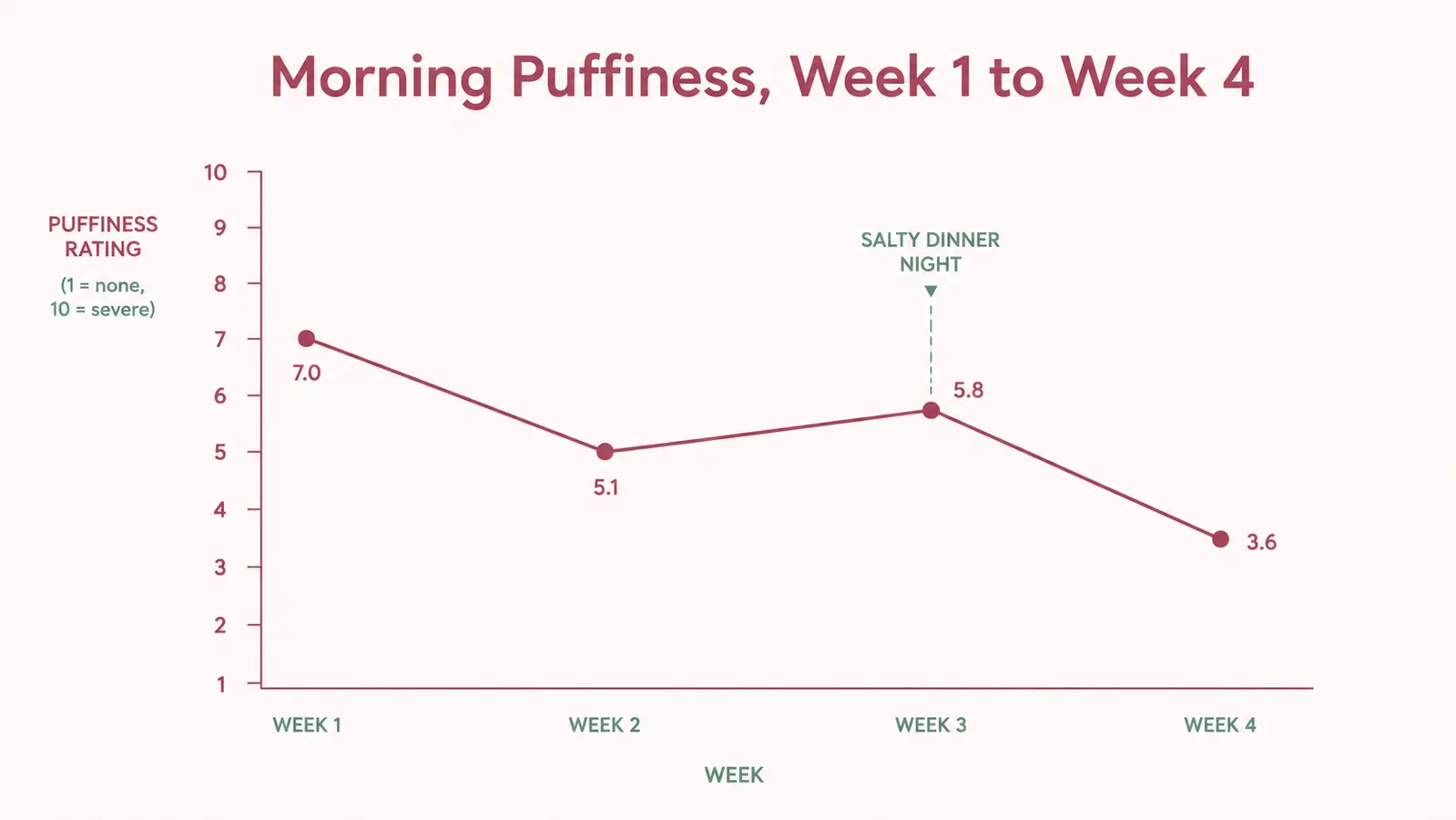
Here's what I actually noticed over four weeks of doing all of this consistently, without rounding it up. The fastest change was from the compress and the sleep and salt adjustments, which softened the worst mornings within the first several days. The eye cream itself moved slower. By week two, I noticed less overall puffiness on an ordinary morning, not just on the good ones. By week four, my baseline, the amount of puffiness on a typical day with no particular cause, was visibly lower than it had been at the start, though a salty dinner or a short night could still bring a puffier morning right back, just from a lower starting point than before.
What didn't change in four weeks was the structural fullness I described in step one, the part that's simply how my under-eye area is shaped now. I didn't expect it to, and I'd be skeptical of any cream, RoC included, promising to erase that kind of hollowing in a month. What four weeks gave me instead was a lower, calmer baseline and a set of habits that catch most of the fluid-driven puffiness before it ever shows up badly in the first place.
What Else Helps
A few smaller habits rounded out the routine without adding much effort. I drink a glass of water first thing in the morning, before coffee, since mild dehydration overnight seems to make puffiness slightly worse the next day. I also stopped rubbing my eyes when they're itchy from allergies, since rubbing irritates the thin skin there and can make puffiness look worse than the allergy itself would on its own. If you want the longer version of how this exact RoC eye cream performed for me over six months, including where it plateaued, I wrote that up in my full long-term review, and the shorter, more direct take on the same tube is in my honest review. If you're still deciding whether a dedicated eye cream is worth adding to your routine at all, I laid out the case more fully in ten reasons a dedicated eye cream helps with dark circles and puffiness.
The compress and the sleep changes fixed the puffy mornings fast. The eye cream lowered the baseline slowly, over weeks, not days. Neither one touched the part of my face that's simply shaped this way now, and I stopped expecting it to.
Ready to Build This Into an Actual Routine?
The compress, the sleep and salt adjustments, and a small nightly amount of eye cream applied the right way brought my morning baseline down within about four weeks. Check today's price on Amazon if you want to start with the same tube I used.
Amazon Check Today's Price on Amazon →